
ONE、Material composition of honeycomb aluminum panel
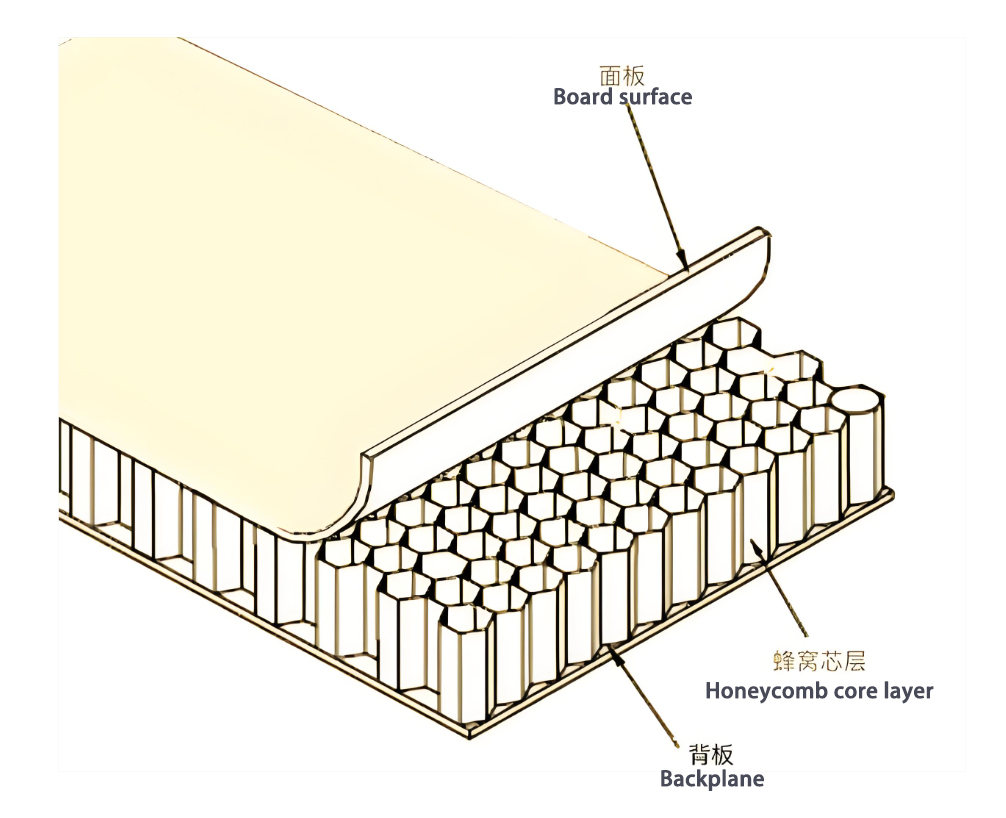
Honeycomb aluminum panel is a typical sandwich composite panel, with its core structure consisting of an aluminum alloy face plate, an aluminum honeycomb core, and an aluminum alloy back plate, arranged from the outside to the inside. These three layers are firmly bonded together using high-performance adhesives. This "skin-core" composite structure endows the material with core characteristics of lightweight and high strength.
1.Panel and backplane: sturdy aluminum alloy "skin"
The face plate and the back plate constitute the upper and lower surfaces of the honeycomb aluminum panel, which are crucial for load transfer, appearance, and durability. For honeycomb aluminum panels used in building curtain walls, the aluminum alloy "skin" has specific technical requirements.
Technical parameters of the panel (front panel)
Thickness Requirements: The average thickness of the aluminum alloy panel should not be less than 1.0mm, and the minimum local thickness at any point should not be less than 0.9mm (excluding the thickness of the surface coating). Base Material: Typically, 3-series (such as 3003 aluminum-manganese alloy) or 5-series (such as 5A02 aluminum-magnesium alloy) aluminum alloys are used. Their chemical composition must comply with the "Deformed Aluminum and Aluminum Alloy Chemical Composition" GB/T3190, and their mechanical properties must comply with the "General Industrial Aluminum and Aluminum Alloy Plate, Strip Part 2: Mechanical Properties" GB/T3880.2.
Surface coating: To meet long-term weather resistance requirements, especially when used for outdoor curtain walls, the surface should be treated with fluorocarbon resin spray coating. Taking the three-coat process as an example, the average thickness of the spray coating should be no less than 40μm, and the minimum local thickness should be no less than 35μm.
Technical parameters of backplane (back panel)
Thickness requirement: The thickness of the backplate is related to the total thickness of the honeycomb aluminum plate, and it is required to be relatively flexible but still has a lower limit. When the total thickness of the honeycomb aluminum plate is 10 millimeters, the average thickness of the back aluminum alloy plate is usually required to be no less than 0.7 millimeters. When the total thickness is greater than 10 millimeters (such as 15 millimeters, 20 millimeters, etc.), the average thickness of the backplate is required to be no less than 0.8 millimeters or 1.0 millimeters (depending on different standards)
The minimum local thickness of the backboard is usually required to be no less than 0.6 millimeters. Materials and Coatings: The substrate material of the backboard should be consistent with that of the panel. The outer surface (i.e. the side facing indoors or towards the structure) usually needs to be coated to meet basic anti-corrosion requirements.
2.Core material: Lightweight aluminum honeycomb "core"
The aluminum honeycomb core in the middle is the core of the honeycomb aluminum plate to achieve lightweight and high strength, and its structure is similar to the honeycomb in nature.
2.1.Structure and Dimensions
Core grid shape: The general specification is a regular hexagonal (or approximately regular hexagonal) honeycomb structure. Core grid edge length: In order to control the stability and mechanical properties of the core material, the edge length is strictly limited. Most standards stipulate that the side length should not exceed 10 millimeters. Some standards require stricter requirements, such as the "Technical Specification for Skylight Roofs and Metal Roofs" JGJ255-2012, which stipulates that it should not exceed 9.53 millimeters; When used outdoors, the "Stone Honeycomb Composite Panel for Building Decoration" JG/T328-2011 stipulates that the side length should not exceed 6 millimeters.
Aluminum foil (wall) thickness: matches the edge length to ensure the rigidity of the wall. For honeycomb structures with side lengths between 6mm and 10mm, the thickness of the aluminum foil should not be less than 0.07mm; For honeycomb with a side length not exceeding 6 millimeters, the thickness of aluminum foil should not be less than 0.05 millimeters.
2.2.Materials and Craftsmanship
Raw materials: Aluminum foil used to manufacture aluminum honeycomb cores, with commonly used grades consistent with panels, such as 3003, 5A02, and other 3 or 5 series aluminum alloys to ensure good corrosion resistance and mechanical properties.
Breathable holes: Aluminum honeycomb cores used for outdoor curtain walls should have breathable micropores on the core wall to balance internal and external air pressure and prevent delamination. Core safety requirements: Honeycomb core materials should not be directly exposed to outdoor environments under any circumstances. During board processing and curtain wall installation, effective edge sealing treatment must be carried out on the board edges (such as folding around the edges, embedding frames, or filling with silicone sealant) to prevent water vapor from entering and causing corrosion of the core material or failure of the adhesive layer.
3.Adhesive: a reliable composite "bond"
The adhesive used to bond panels, backboards, and aluminum honeycomb cores is the lifeline to ensure the structural integrity of composite panels, and its performance is crucial. Main types: Adhesives used for core material composite, mainly modified epoxy resin or modified polyurethane adhesives. Key performance indicators: Relevant standards impose strict physical, chemical, and weather resistance requirements on adhesives. The main technical specifications are shown in the table below:
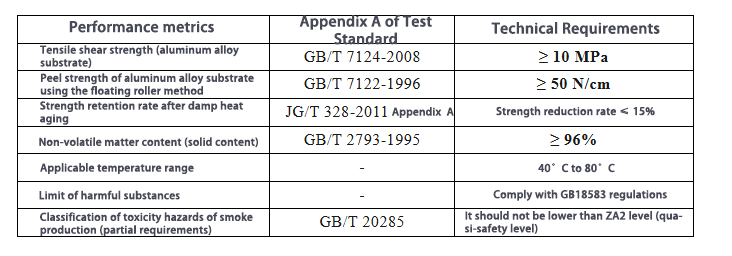
The performance of these adhesives directly determines the drum peel strength and tensile strength of honeycomb aluminum panels, which are the core parameters for measuring the bonding quality between core materials and panels. The current mainstream standard requires the average peel strength of the drum to be ≥ 90N · mm/mm, and the flat tensile strength to be flat. Mean ≥ 0.8N/mm2.
In summary, the material composition of honeycomb aluminum plate is a precise collaborative system: specific specifications of aluminum alloy panels and backboards are firmly bonded to the aluminum honeycomb core with controlled structural dimensions through high-performance adhesives. The selection and parameter setting of all materials collectively point to the required strength, stiffness, durability, and long-term safety of curtain wall panels.
TWO、Introduction to Honeycomb Aluminum Curtain Wall Materials
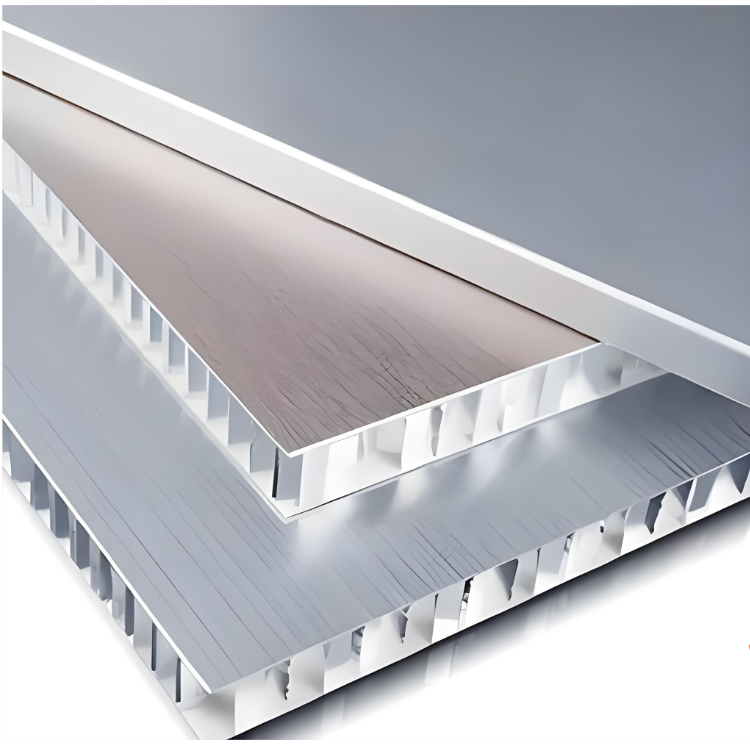
As a continuation of the detailed analysis of material composition in the previous text, the application value of honeycomb aluminum panels in the field of building curtain walls is precisely due to their unique "skin core material" sandwich composite structure. This structural design inherits the excellent weather resistance of metal sheets and gives rise to a series of comprehensive properties that surpass traditional single materials, making it a high-performance solution for curtain wall panels.
1.Overview of Core Performance Characteristics
Based on its composite structure, honeycomb aluminum panels exhibit the following core characteristics:
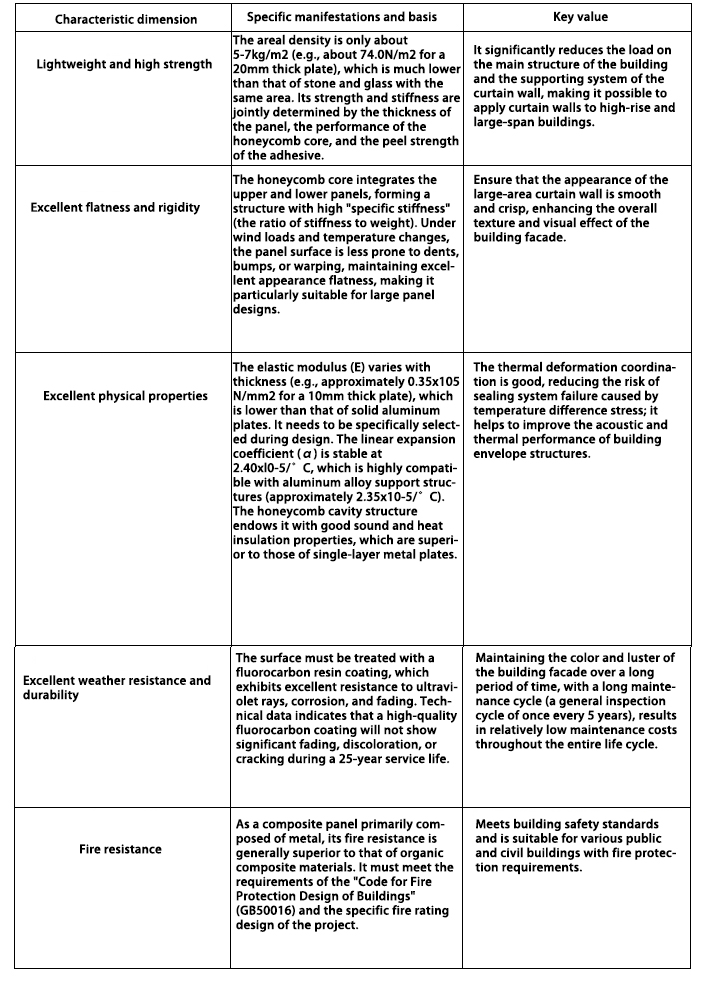
2.Comparative advantages over traditional curtain wall materials
To more clearly define the characteristics of honeycomb aluminum panels, a brief comparison is made between them and several traditional curtain wall panel materials:
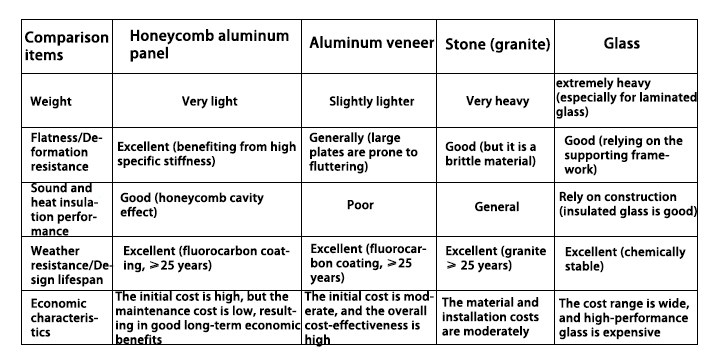
By comparison, it can be seen that the core advantage of honeycomb aluminum plate lies in comprehensively solving the contradiction between "lightweight" and "high flatness and high stiffness", while also considering good physical properties and long life. It is particularly suitable for high-end building projects that have strict requirements for the flatness of curtain wall panels, pursue large grid and simple facade effects, and require control of structural loads.
3.Application positioning and economic overview
In building curtain wall systems, honeycomb aluminum panels are positioned for mid to high end application scenarios. Its initial material and manufacturing cost are higher than ordinary aluminum veneer, mainly due to complex composite material processes and strict quality control (such as high requirements for peel strength). However, with its long weather resistance, low maintenance frequency, and potential energy-saving benefits during operation (thanks to its insulation performance), from the perspective of life cycle cost (LCC), its long-term economy often demonstrates advantages, in line with the concept of sustainable buildings.
THREE、Application conditions of honeycomb aluminum panel curtain wall
Honeycomb aluminum panels are not unconditionally applicable when used in building curtain walls. Its excellent performance can only be fully utilized under a series of strict engineering, environmental, and regulatory conditions, ensuring the long-term safety and durability of the system. This chapter elaborates on the core conditions that must be followed when applying honeycomb aluminum panel curtain walls based on current national and local technical specifications.
1.Height and regional regulatory restrictions
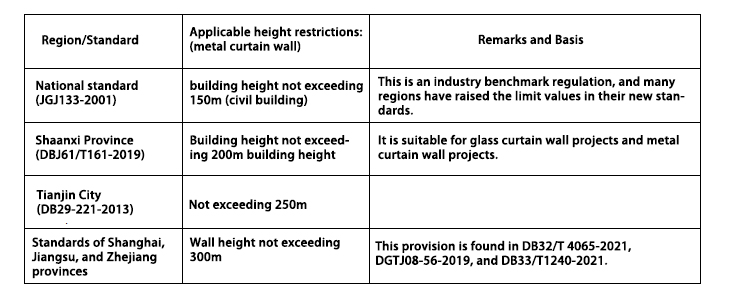
The application of honeycomb aluminum panel curtain wall is first strictly limited by the building height, and the specific limit value must comply with the mandatory technical standards of the project location.
Core application conditions:
Primary principle: Project design must prioritize compliance with the latest effective local technical standards in the location of the project. If there are no local standards, refer to national industry standards.
Exceeding the limit: When the proposed building height exceeds the above limit, special technical demonstration and safety assessment must be conducted, and if necessary, verification through tests (such as vibration table seismic tests) must be carried out.
2.Environmental adaptability conditions
The honeycomb aluminum panel curtain wall system needs to be able to adapt to long-term climate and environmental effects, and temperature effects and weather resistance must be fully considered in the design.
2.1Performance conditions for thermal expansion and contraction
Material parameters: The standard linear expansion coefficient of aluminum honeycomb (composite) panels, a=2.40x10⁻⁵/° C, must be used for design and calculation. Joint design: The joints of curtain wall panels must be able to absorb deformation caused by temperature changes. The width of the adhesive joint needs to be determined through calculation (including parameters such as a, annual temperature change AT, panel edge length, and sealant displacement ability 8), and should not be less than the specified minimum value.
Construction measures: The supporting keel (column) should be equipped with movable joints to absorb vertical temperature deformation. The curtain wall system should be able to adapt to in-plane deformation of three times the elastic interlayer displacement value of the main structure.
2.2Weather resistance conditions
Material selection: Weather resistant materials must be selected, and metal materials need to undergo effective surface anti-corrosion treatment (such as fluorocarbon spraying). Special requirements in cold regions: In cold climate environments, special attention should be paid to the differences in linear expansion coefficients between different components such as panels (aluminum alloys), adhesives, honeycomb cores, etc. (adhesives are usually 6.0-10.0x10⁻⁵/° C) to prevent overall deformation or bonding failure of composite panels caused by cold and hot cycles.
Moisture proof and ventilation structure: A minimum of 50mm of air layer (ventilation layer) should be retained between the curtain wall panel and the outer surface of the main structure to facilitate the discharge of water vapor and prevent internal condensation, which is particularly important in frost prone areas. Verification test: For important or complex engineering projects, thermal cycling durability tests (refer to JG/T397) should be conducted to verify their ability to maintain performance under repeated temperature changes.
3.Structural safety design conditions
Honeycomb aluminum panels, as curtain wall panels, require strict calculation and verification to ensure their structural safety.
3.1Wind load design requirements
Load value: The standard wind load value wk should be calculated according to the prescribed formula, and the calculation result should not be less than 1.0kN/m2. For complex or important buildings, wind load values should be determined through wind tunnel tests. Load combination: When the panel component is subjected to two orthogonal wind loads simultaneously, the strength calculation needs to be carried out through bidirectional combination verification according to 1.0X+0.6Y and 1.0Y+0.6X.
Panel verification: Honeycomb aluminum plates need to undergo strength and deflection verification. When calculating, it is necessary to consider the influence of geometric nonlinearity (large deflection) and use a reduction factor n.
Deflection limit: Under the standard value of wind load, the deflection of honeycomb aluminum plate shall not exceed 1/60 of its supporting edge length.
3.2 Material safety factor conditions
Panel safety factor: As a panel material, honeycomb aluminum plate has a total safety factor K of 2.0 (according to JGJ133-2001). The strength design value should be obtained by dividing the average strength test value provided by the manufacturer (as a standard value) by a coefficient of 1.428 (K2=K/Yw=2.0/1.4)
Load sub factor: When designing the ultimate limit state of bearing capacity, the sub factors that should be used are: gravity load y_G=1.2 (unfavorable) or 1.0 (favorable), wind load y_w=1.4, and seismic action y_E=1.4.
4.Mandatory conditions for construction and waterproof sealing
The performance of materials and designs is ultimately achieved through precise construction and sealing, and the following are mandatory application conditions that must be met.
4.1Sheet metal processing and edge sealing conditions
Total thickness: The total thickness of the honeycomb aluminum panel section used for curtain walls should not be less than 10mm. Panel and back panel thickness: The average thickness of the panel (decorative surface) should not be less than 1.0mm (minimum local thickness ≥ 0.9mm). The thickness of the backplate depends on the total thickness: ≥ 0.7 mm when the total thickness is 10mm; ≥ 0.8mm~1.0mm when the total thickness is>10mm (specific according to local standards)
Mandatory edge banding: Honeycomb core material shall not be exposed to the atmosphere under any circumstances. The edges of the board must be tightly sealed by folding or framing around it. The exposed edge of the board at the corner must also be sealed or filled with sealant to make it smooth.
4.2Installation and Connection Conditions
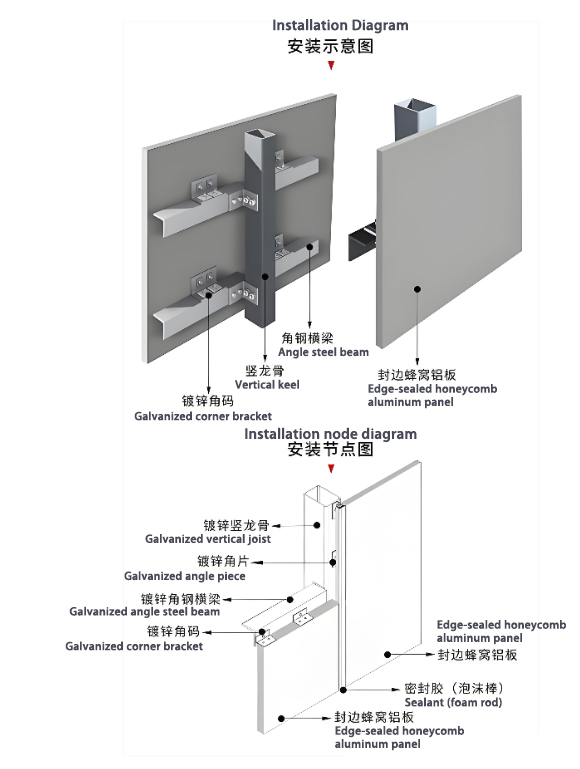
Connection method: Mainly adopts hanging or crimping connection.
Pre embedding requirements: Irregular nuts used for back connections must be pre embedded in the factory, and temporary on-site embedding is strictly prohibited.
Board seam width: For hanging connections, the board seam width should not be less than 10mm; for crimping connections, the board seam width should not be less than 25mm
4.3Systematic conditions for waterproof sealing
Selection of sealant: Silicone building sealant (weather resistant sealant) must be used for board joint sealing. Neutral silicone sealant should be used when in contact with metal, and compatibility and adhesion test reports must be provided. Adhesive seam size: The thickness of the sealant application should not be less than 3.5mm (or 5mm, according to local standards), the width should not be less than twice the thickness, and it should form two sided bonding to avoid three sided bonding. Opening treatment: For open panel joint design, an independent waterproof layer (such as waterproof lining board) and a reliable drainage system must be set up on the back of the panel.
Openings and Cut Sealing: All exposed core material parts such as openings and cuts during the processing must be sealed with neutral silicone sealant.
Drainage slope: The drainage slope of the top of the curtain wall, canopy, and roof should not be less than 3%.

High quality products, high-quality services and high-quality

Focus on us
HANBERT
Tel: 0757-22682270
Phone: +86-135 314 008 83
E-mail: info@hanbert-tech.com
Address: 1612,4th,building,ZhiyePlaza,Daliang,Foshan,Guangdong P.R.of china
Copyright © 2021-2026 HANBERT All Rights Reserved. 粤ICP备2021118030号  Power by:
 Hanelink.com