

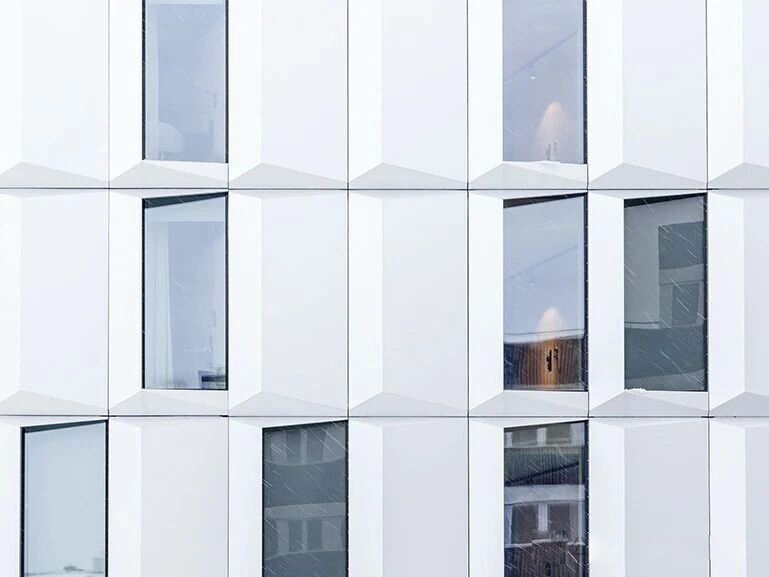
Common problem: Currently, most of the aluminum curtain walls in public and residential buildings are deformed. There are obvious wave deformations on the surface of the board, accompanied by bulges, depressions, and warping, and even twisting.
Other common causes include insufficient reinforcement or improper connection, improper folding design, insufficient thickness (such as less than 2.5mm) or negative tolerance, perforation scheme not matching the structure, and so on.

Design recommendation: In order to reduce the deformation of aluminum curtain walls caused by design reasons, it is necessary to improve their high-quality design level.
·Strictly control the insufficient setting or improper connection of reinforcement bars. 300-500mm reinforcement bars can be used to eliminate the practice of no reinforcement bars. In addition, the reinforcement ribs and folded edges need to be effectively connected to form an overall force and stiffness;
·Improper design of the folded edge can be strictly controlled, with the minimum size of the folded edge controlled at 25mm or above, and the 20mm folded edge size cancelled. For large grid panels, it is recommended to have a minimum folded edge size of 30mm or more;
·Strict control of insufficient thickness (such as less than 2.5mm) can be achieved by using aluminum plates with a thickness of 3.0mm or above. High standard projects can choose 10-25mm thick honeycomb aluminum panels to improve their panel flatness. The thickness of perforated aluminum plate can be increased by another 0.5mm;
·Strictly controlling the inconsistency between perforation scheme and structure can be due to the integration of perforation scheme and structure, and the perforation pattern needs to be mechanically optimized.

High quality products, high-quality services and high-quality

Focus on us
HANBERT
Tel: 0757-22682270
Phone: +86-135 314 008 83
E-mail: info@hanbert-tech.com
Address: 1612,4th,building,ZhiyePlaza,Daliang,Foshan,Guangdong P.R.of china
Copyright © 2021-2026 HANBERT All Rights Reserved. 粤ICP备2021118030号  Power by:
 Hanelink.com